Retiring a Miner Without Guesswork
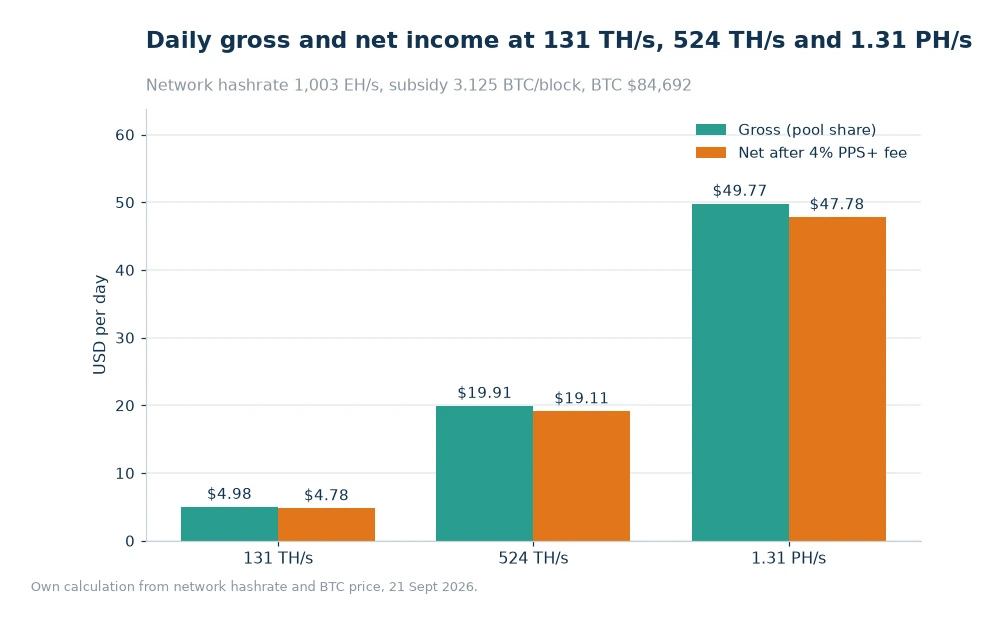
A 131 TH/s unit settles $4.78 a day after the listed 4%, but at 30 joules per terahash it burns $5.66 of power to do it. The same machine at 20 joules leaves $1.01 a day, and at 25 joules it leaves six cents. Retiring the right unit is a margin question, and the margin is decided by two numbers the operator can measure.

Key takeaways
- 131 TH/s settles $4.78 a day; 524 TH/s settles $19.11 and 1.31 PH/s settles $47.78.
- At 20 J/TH the power bill is $3.77 a day, leaving $1.01 of margin before cooling.
- At 30 J/TH the bill reaches $5.66, which is $0.88 more than the unit earns.
- A unit in the 25 J/TH band is the hardest call, because six cents a day is neither a keeper nor an obvious failure.
A fleet ages unevenly
Machines bought together do not degrade together. One rack sits in a cooler corner, another draws the dusty air from the loading door, and a third has had a fan replaced with a part that spins a little slower. After two years the fleet is a spread of efficiencies rather than a block, and the average hides the unit that has quietly become a net cost.
A ViaBTC Miner Ranking row gives each model a current dollar figure, and the same logic applies inside a fleet: rank the units you own, not just the units on sale. The natural management instinct is to look at age. The oldest machines are the candidates for retirement, the reasoning goes, because they are nearest the end of their useful life. That is a proxy, and proxies fail exactly when the fleet is mixed. A three-year-old unit that has been kept clean and cool can be more profitable than a two-year-old one that has been baking in a hot aisle.
The sheet is also a record, so a decision made in March can be reviewed in September.
The alternative is to rank by margin per day at current conditions. It takes an hour to build the sheet and it answers the retirement question directly, because the units at the bottom of that ranking are the ones whose power bill is closest to their credit.
Three columns decide a retirement
The first column is the settled credit at the unit's measured hashrate. Not the nameplate figure, and not the number from the purchase invoice: the number the pool actually credits, averaged over a week. A unit that has lost 8% of its hashrate through throttling has lost 8% of its credit, and the meter will not reflect that.
The second is the measured wall power, taken with a clamp meter at the same time as the hashrate reading. Together the two give joules per terahash, which is the only efficiency figure worth comparing across models and ages.
The third is the tariff, including any demand charge that applies to the site. A machine that clears a flat energy rate can fail once a demand charge is allocated across the racks, and the allocation is a site decision rather than a machine property. Being explicit about it prevents an argument later about why the spreadsheet said keep and the accountant said stop.
Demand charges deserve their own line because they punish exactly the wrong thing. They are billed on the peak draw in a window, so a rack that starts every machine at once can set a peak that costs money all month, even if the average is modest. Staggering restarts after an outage is a cheap habit that keeps the peak down, and it is invisible in any per-machine calculation.
What a 131 TH/s unit must clear
At a settled credit of $4.78 a day, the break-even wall power is $4.78 ÷ 0.06, which is 79.7 kWh a day, or 3,320 W averaged across 24 hours. Divide by 131 TH/s and the efficiency ceiling is 25.3 J/TH. Anything worse than that loses money at this tariff before cooling is counted.
That ceiling moves with the tariff, which is why two operators can disagree about the same model without either being wrong. At $0.04 per kWh the ceiling is 38 J/TH and almost everything survives; at $0.10 it is 15.2 J/TH and almost nothing does. The machine is the same in both cases; the site is not.
It also moves with difficulty. A 5% rise in network difficulty cuts the credit by roughly 5%, which lowers the break-even power by the same proportion and can push a marginal unit over the line without any change to the hardware. That is why the watch list should be reviewed after each adjustment rather than once a quarter.
Keep, watch, retire
The table sets the three decisions against measured efficiency. The middle row is deliberately uncomfortable: a six-cent daily margin is a rounding error away from zero and will flip sign at the next difficulty adjustment.
| Measured efficiency | Wall power | Power per day | Margin per day | Call |
|---|---|---|---|---|
| 20 J/TH | 2,620 W | $3.77 | +$1.01 | Keep |
| 25 J/TH | 3,275 W | $4.72 | +$0.06 | Watch weekly |
| 30 J/TH | 3,930 W | $5.66 | −$0.88 | Retire |
Retirement is not always physical. A unit that fails at one site may clear at another with cheaper power, which is why the second-hand market exists and why a machine sold at a loss to one operator can be a sensible buy for another. The decision is about the unit at a location, not about the unit in the abstract. Write the site into the row label so the sheet cannot be misread six months later.
There is a maintenance angle as well. Before retiring anything, clean the heatsinks and check the fans; a unit that measures 30 J/TH while clogged with dust may measure 26 after an hour of work, and 26 is a different decision. Cleaning is the cheapest efficiency upgrade available, and it is frequently skipped because it does not arrive in a box.
Worked example
Take the 131 TH/s unit from credit to break-even ceiling, then test the two marginal cases.
- Per-TH/s figure: 450 ÷ 1,003,000,000 = 0.00000044865 BTC each day.
- 131 TH/s: 131 × 0.00000044865 = 0.00005877 BTC, written 5.877e-05.
- Gross: 0.00005877 × 84,692 = $4.98.
- Listed charge: 4.98 × 0.04 = $0.20, leaving $4.78.
- Break-even energy: 4.78 ÷ 0.06 = 79.67 kWh a day; ÷ 24 = 3.32 kW.
- Break-even efficiency: 3,320 W ÷ 131 TH/s = 25.3 J/TH.
- At 25 J/TH: 3,275 W × 24 = 78.6 kWh; × 0.06 = $4.72; margin $0.06.
- At 30 J/TH: 3,930 W × 24 = 94.32 kWh; × 0.06 = $5.66; margin −$0.88, or −$26.40 a month.
- A 5% difficulty rise takes the credit to about $4.54, which lowers the break-even power to 75.7 kWh a day and pushes the 25 J/TH unit to −$0.18.
Frequently asked questions
At what efficiency should a 131 TH/s unit be retired?
Above roughly 25.3 J/TH it stops covering its power at $0.06 per kWh and a $4.78 settled credit, so a unit measuring 30 J/TH is losing about $0.88 a day and should be retired or moved to a cheaper site.
Is age a good reason to retire a miner?
No, margin is. A clean, cool three-year-old unit at 20 J/TH earns $1.01 a day while a dusty two-year-old at 30 J/TH loses $0.88, so the calendar is a poor guide compared with a clamp meter.
Can a retired unit still be useful?
Yes, if another site has cheaper power: at $0.04 per kWh the break-even ceiling rises to about 38 J/TH, so a machine that fails at one location can clear its bill at another.
Retire in the order the numbers give you
Build the sheet once with three columns — settled credit, measured wall power, tariff — and sort by margin. Retire from the bottom until every remaining unit clears its power bill with enough left for cooling and repairs. The Mining Farms listings show where a retired unit might still find cheap power, and the fee schedule confirms what the pool keeps from the units you keep. A fleet trimmed by measurement is smaller and easier to run than one held together by sentiment.
Sources: ViaBTC ranking, farms and pricing pages[1]. Read 21 Sept 2026: network hashrate 1,003 EH/s, difficulty 132.76 T, subsidy 3.125 BTC, 144 blocks a day, BTC $84,692. Published 24 Oct 2026; margins are before cooling, repairs and hosting.