How Text Generation Produces a Reply
A reply in a text-based companion is produced by weighing the material in front of it: the character's written setup, the messages already in the thread, and whatever the service is designed to carry forward between sessions. The operator's description is that responses are natural and adaptive, and that characters recall previous interactions and express emotions over time. Nothing in that description requires a human on the other end, which matches the platform's compliance statement that its content is AI-generated text.

Key takeaways
- Four things feed a reply: your message, the thread so far, the character's setup, and the preferences the service remembers for the account.
- Length follows context. A one-line prompt leaves less to build on than a message that adds a fact, a question or a decision.
- Replies vary between attempts because generation weighs probabilities rather than replaying a stored script.
- Volume compounds quietly: 12 messages a day is 360 a month, while 150 a day is 4,500, so thread length is a reader-controlled variable.
The four inputs
The first input is the message you just sent. It is the most immediate constraint, because a specific statement narrows the space of sensible replies while a vague one leaves the reply to fall back on the broadest thing the character could say.
The second is the thread. A generation step looks at what has been established so far, which is why the twentieth message in a conversation sounds different from the second. Register, vocabulary and pacing all accumulate.
The third is the character's setup, written by whoever created the card. That setup is the reason two cards with identical labels can produce completely different replies: one supplies a role, a tone and a situation, the other supplies a name and little else.
The fourth is the account's remembered preferences. Crushon describes characters that recall previous interactions, which is continuity carried forward rather than a fresh start each session. Treat it the way you would treat a note left for yourself: useful, partial, and worth keeping accurate.
Why the same prompt gives different replies
Text generation weighs options rather than looking up an answer, so a reply is one plausible continuation among several. Send the same opening line twice and the two results will share a family resemblance and differ in detail. That variability is a feature of the method, not a fault in the service.
It also explains the common complaint that a companion "forgot" something from ten messages ago. What is available to a generation step is the context the service carries, and a long thread pushes the earliest material further from the front of that context. When a thread gets unwieldy, a fresh session with the setup restated often reads better than continuing to pile on.
| Input | Reader control | Effect on the reply | Weak-input symptom |
|---|---|---|---|
| Your message | Complete | Sets the immediate subject and register | Replies circle back to the opening |
| Thread length | High | Carries tone and earlier facts | Old details stop appearing |
| Character setup | Indirect, by card choice | Supplies voice and role | Replies sound generic |
| Remembered preferences | Partial | Keeps style consistent across sessions | A companion contradicts itself |
Worked example: thread length over six weeks
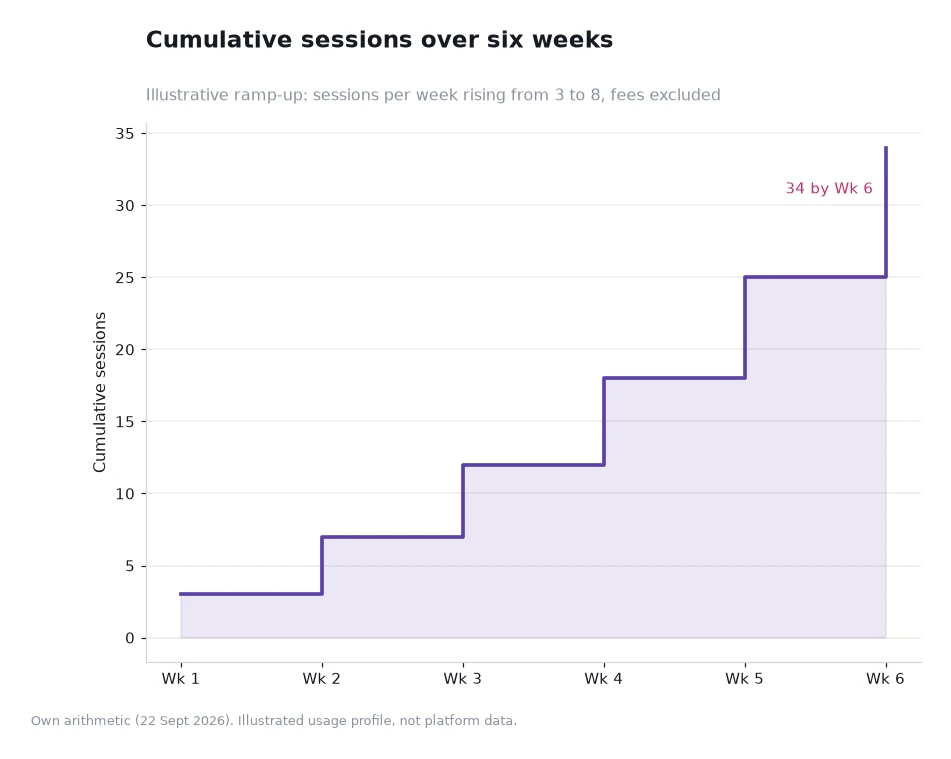
The chart below charts cumulative sessions across six illustrative weeks: three in week one, then four, five, six, seven and nine. Added up, 3 + 4 + 5 + 6 + 7 + 9 = 34 sessions, and the running total at the end of each week reads 3, 7, 12, 18, 25 and 34.
Attach a message count to that. At ten messages a session, the first week holds 30 messages and the six-week total holds 340. At 25 messages a session the six-week figure becomes 850. Both readings start from the same 34 sessions, so the multiplier is entirely a function of how long each session runs — a figure you choose.
Those session counts and per-session message counts are illustrative assumptions, not platform data. The useful conclusion is modest but real: if a long thread dulls a companion's recall of the setup, then shorter, more frequent sessions preserve context better than a single weekly marathon. Crushon's design carries context forward, and context that is worth carrying is easiest to keep when the thread never grows far beyond what you still remember yourself.
What generation does not do
It does not reach outside the service. The remembered preferences and thread context belong to the account and the conversation; there is no wider knowledge of the reader beyond that, and the compliance statement's point that no real person is depicted should be read the same way — the content is text, generated for the conversation.
It also does not decide what is allowed. Rules are set by the operator, and the platform notes that some limitations apply in line with its content and community guidelines. A Porn Chat AI reply that declines something is following that boundary rather than making a judgement about the reader, which is why the boundary is published rather than implied.
Understanding those two limits makes the rest easier to work with. If you want a specific kind of reply, supply specific material: a detail, a decision, a question that has more than one answer. The porn ai chat page hosts all the entry points; the mechanics of producing a reply are what you bring the material for.
Two practical extensions follow from that. Keep a short list of five cards you know well instead of chasing new ones every week, because a familiar setup is what makes a long thread readable, and the character search is the quickest way to confirm that a card you liked still matches the labels you use. It is also worth reading one or two of the operator's own explainers, since the write-ups on the AI chat blog use the same vocabulary the product does and remove most of the guesswork about what a reply can be asked to hold.
Frequently asked questions
Is a reply written in advance and stored?
No. It is generated when you send a message, which is why the same prompt can produce two different replies and why a thread's style develops as it goes.
Why does the companion sometimes lose an early detail?
Because a long thread pushes old material further back in the context that is available. Restating a key fact, or starting a fresh session, brings the setup forward again.
Do my messages get better replies if they are longer?
Specific messages do. Two sentences carrying one new fact beat a long message that restates what the thread already knows.
Does generation use anything from outside the conversation?
The service describes remembered preferences and recalled interactions for the account, so continuity comes from your own use of the platform rather than from anywhere else.
Give the reply something to work with
Generation is a mirror of input quality. State the scene once, add one concrete detail per message, keep sessions short enough that the setup stays visible, and the replies will read as continuous writing rather than as generic responses. Start with a single card and 20 messages, then compare that thread with a second card treated the same way, and the difference between a well-written setup and a thin one becomes measurable in about a quarter of an hour.
Data and sources: the platform's wording on adaptive responses, recalled interactions and remembered preferences, and the 2257 compliance statement[1], read 22 Sept 2026. Session and message counts are own arithmetic on an illustrated profile. This article is intended for adults aged 18 and above.